
Peptide crystallization
Improving peptide purification, solid-state properties and processability
Peptide crystallization offers an alternative to chromatographic purification, with the potential to reduce costs and simplify downstream processing for both final active pharmaceutical ingredients (APIs) and peptidic intermediates.
This is particularly relevant in convergent synthesis strategies, where highly pure peptide fragments are essential for subsequent coupling steps. Therefore, replacing chromatographic purification with crystallization, improves process efficiency and reduce overall synthesis costs.
However, the large size, conformational flexibility and multiple ionizable groups of peptides make crystallization significantly more challenging than for conventional small molecules.
At Enantia, we apply our expertise in complex crystallization, developed through years of experience in solid-state research and cocrystal development, to address these challenges. In response to the growing demand in the peptide field, we have expanded our capabilities to peptide crystallization. Our tailored approaches aim to improve purification, solid-state properties and processability.
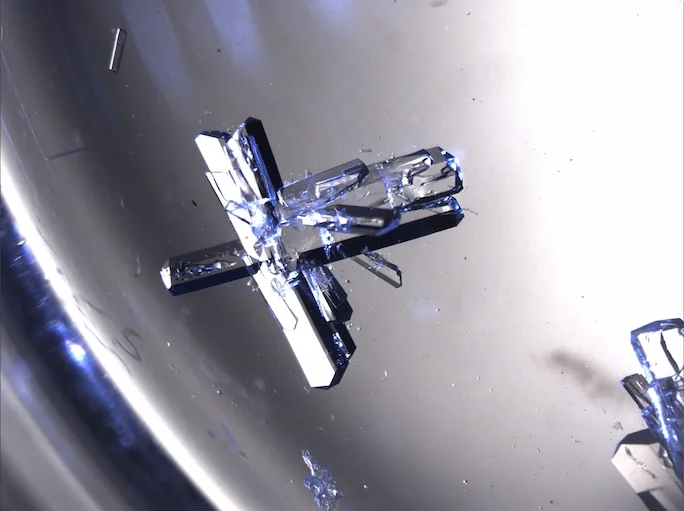
Peptide Crystallization Challenges and Opportunities
Peptides present specific crystallization challenges compared with small molecules, mainly due to their high conformational flexibility, extensive hydrogen-bonding networks and multiple ionization states tend to hinder crystal formation. These characteristics generally lead to amorphous solids, gelation, aggregation, fibrillation or oiling out.
As a result, peptide purification is generally carried out by chromatography. In addition, the resulting solid forms often exhibit poor physical properties and limited processability, posing additional challenges for downstream processing and pharmaceutical drug development.
Developing suitable peptide crystalline forms can offer several benefits:
- More robust and cost-effective isolation processes: Development of reproducible crystallization conditions suited to the characteristics of each peptide, reducing purification costs compared with column chromatography.
- Improved purification: Enhanced impurity rejection in the isolation of final peptide APIs and peptidic intermediates.
- Improved stability and processability: Identification of crystalline forms with favourable solid-state properties and better filtration and drying behaviour, with reduced risks of gelation, aggregation and oiling out.
- Intellectual property opportunities: Identification of new crystalline forms provide additional opportunities to strengthen IP protection beyond the peptide’s underlying composition of matter.